
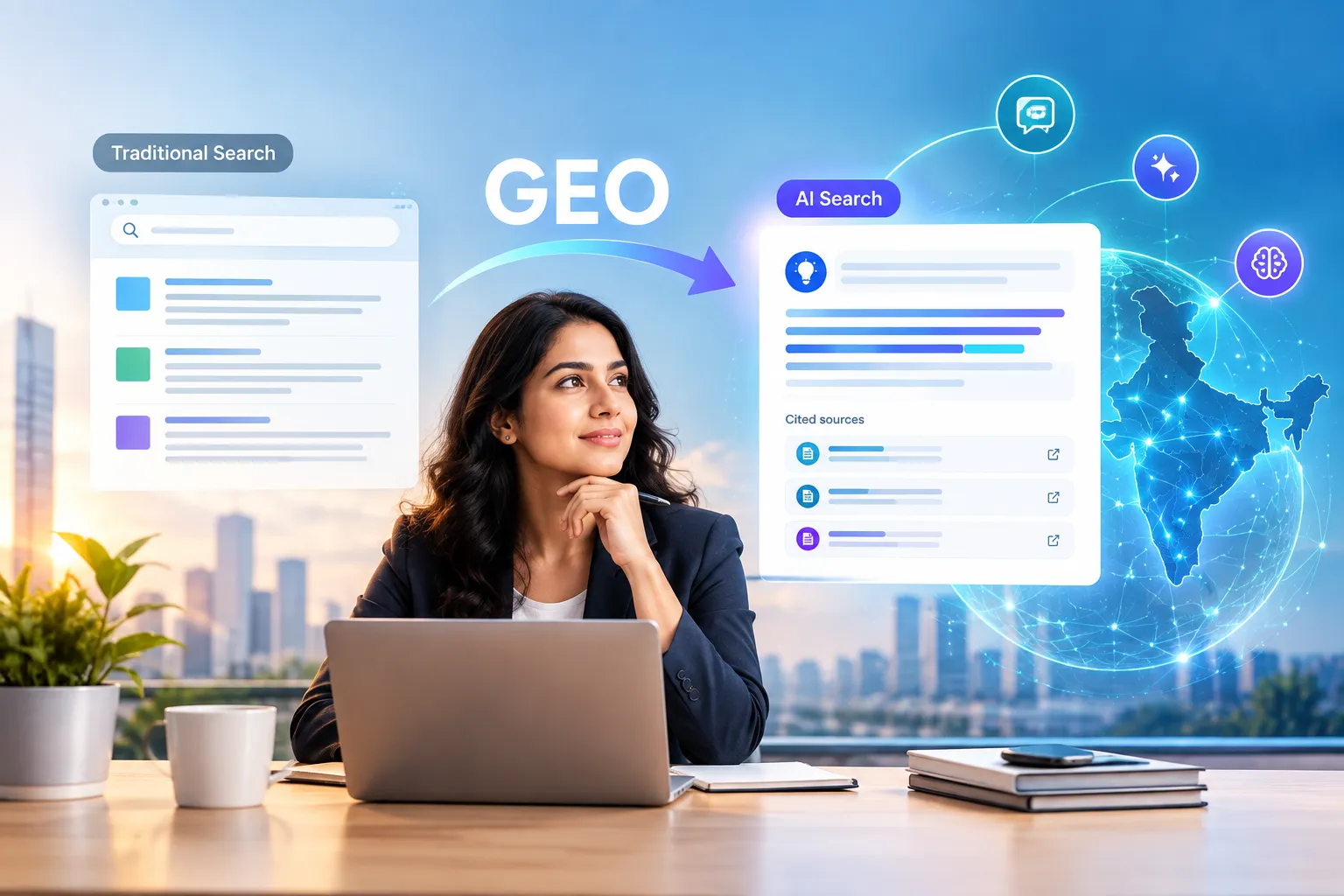
Type something into ChatGPT, Gemini, Claude, Perplexity, or Grok today, and none of them hand you ten blue links. They hand you an answer. Sometimes they even name a brand while they’re at it.
That single shift is rewriting the rules of online visibility. Ranking on page one of Google still matters, but now there’s a second scoreboard: does the AI mention you at all?
This is where Generative Engine Optimization (GEO) enters the picture. If you run a business in India and you’ve been hearing this term everywhere lately, this article breaks down what it actually means, how it works, and why it deserves a spot in your 2026 marketing plan.
What is Generative Engine Optimization (GEO)?
Generative Engine Optimization is the practice of shaping your content so AI systems like ChatGPT, Google AI Overviews, Perplexity, and Gemini pick it up, quote it, and credit you when they answer a user’s question.
The term isn’t marketing fluff someone invented for a LinkedIn post. It comes from an actual academic paper, “GEO: Generative Engine Optimization,” published by researchers from Princeton, Georgia Tech, and IIT Delhi. The researchers built GEO as the first framework designed to help content creators improve their visibility inside generative engine responses, using a flexible optimization approach that works even though the ranking logic of these AI systems stays hidden.
Here’s the part that should get your attention: their tests showed that applying GEO techniques can lift a brand’s visibility in AI-generated answers by as much as 40%. That’s not a rounding error. That’s the difference between being invisible and being the source ChatGPT, Gemini, Claude, Perplexity, or Grok actually leans on when a user asks a question.
In simple words, GEO does for AI chatbots what SEO did for Google two decades ago. Except this time, there’s no list of ten results to fight over. There’s just one answer, and either you’re part of it or you’re not.
How Does Generative Engine Optimization Work?
Traditional search engines rank entire web pages. Generative engines work differently — they pull small chunks of text, called passages, from multiple sources and stitch them into one summarized answer.
That single fact changes everything about how you should write.
Because large language models extract and use small text chunks rather than judging a whole page, content needs to be optimized at the passage level, not just the page level. A vague, keyword-stuffed paragraph won’t get picked. A clear, self-contained answer will.
Research also found that adding real statistics, citations, and credible references to your content noticeably increases the chance of that content being used in AI-generated answers, while old-school tricks like keyword stuffing barely move the needle anymore.
So what actually helps?
- Direct, specific answers. Write the way you’d explain something to a smart friend, not the way you’d write for a Google crawler from 2015.
- Clear structure. Headings, short paragraphs, and bullet points make it easy for an AI to lift a clean passage.
- Real data and sources. Numbers and citations build the kind of trust that gets you quoted.
- Original insight. AI models are trained on the entire internet. Repeating what everyone else already said gives them no reason to pick you specifically.
Think of GEO as writing content that’s easy for a machine to “borrow” and easy for a human to trust once it’s borrowed.
GEO vs SEO: What’s the Difference?
People keep asking “GEO vs SEO,” as if one is about to replace the other in a dramatic showdown. It’s less of a fight and more of a relay race — SEO gets you discovered, GEO gets you quoted.
| Factor | SEO | GEO |
| Goal | Rank high in search results | Get cited inside AI-generated answers |
| Unit optimized | Whole webpage | Individual passages and paragraphs |
| Key signals | Keywords, backlinks, page speed | Clarity, citations, statistics, structure |
| Output for user | A list of links | A direct, synthesized answer |
| Visible metric | Ranking position, CTR | Mention frequency, citation share |
Notice that GEO doesn’t throw SEO out the window. A technically weak website with poor E-E-A-T signals rarely gets crawled well by AI engines either, since most of them still lean on search indexes for their base layer of data. Good SEO is the foundation. GEO is the layer you build on top of it.
What is the Difference Between SEO, AEO and GEO?
This is where things get a little crowded, because a third acronym joined the party: AEO (Answer Engine Optimization).
A recent academic paper describes SEO as the practice of achieving high rankings in search results, while AEO targets direct-answer features like featured snippets, and GEO addresses optimization for generative AI models such as ChatGPT. The same paper argues that businesses now need a combined approach — one that treats E-E-A-T, semantic richness, and brand reputation as a single strategy rather than three separate checklists.
In plain terms:
- SEO gets you found on Google.
- AEO gets you into featured snippets and voice assistant answers.
- GEO gets you cited by AI chatbots.
You don’t pick one. You build all three into the same content, because they overlap far more than they compete.
Why Do Indian Businesses Need GEO in 2026?
Here’s where the humour dies down a bit, because the numbers are genuinely big.
India’s active internet user base crossed 950 million in 2025, according to an IAMAI report, with rural India now forming the majority of that base. That’s not a niche audience anymore. That’s most of the country.
On the AI side, ChatGPT crossed 900 million weekly active users in 2026, more than double the figure from the same period the previous year, and India is consistently one of its largest user bases globally. Google’s Gemini isn’t far behind — it passed 1 billion monthly active users in August 2026, making it the fastest-growing product in Google’s history, and Gemini is now baked directly into Search, Gmail, and Android for hundreds of millions of Indian users who never even download a separate app. Perplexity is smaller in scale but growing fast, with monthly active users climbing from a few million to well over 30 million within a couple of years, largely because people use it specifically to get a sourced, cited answer instead of a list of links. Claude and Grok round out the field — Claude leans heavily into enterprise and professional use (including inside tools many Indian companies already run on), while Grok rides on X’s massive existing user base to answer questions in real time.
The names differ, but the pattern doesn’t: a meaningful chunk of your potential customers are already asking one of these tools questions like “best CA firm in Jaipur” or “which digital marketing agency should I hire” before they ever open Google.
If your business isn’t structured for AI to understand and quote, you’re simply not part of that conversation on any of these platforms. It’s not that Google stopped mattering. It’s that several new fronts opened up at once, and most Indian businesses haven’t even noticed the war started.
The Shift From Search Results to Search Answers
A decade ago, users typed three words and scrolled through results. Now they type full questions and expect one confident answer, delivered in seconds, often with zero clicks to your website.
This is uncomfortable for anyone measuring success purely in website traffic. But it’s also an opportunity. Being the brand an AI trusts enough to quote by name carries more weight than being link number six on a results page nobody scrolls to anymore.
Local Businesses and Trust in AI Search
Indian SMBs have historically played catch-up on SEO. GEO is oddly more forgiving to smaller, honest players — because generative engines reward clarity and credibility over sheer backlink volume. A well-documented, transparent local business page can genuinely out-cite a bloated enterprise site that never bothered to explain anything clearly, which is exactly why working with an experienced SEO agency in India that understands both local search and AI visibility matters more than ever.
That’s a rare kind of levelling for Indian small and mid-sized businesses, and it won’t stay this open forever.
How Can Indian Businesses Optimize for ChatGPT, Gemini, Claude, Grok, and Perplexity?
Let’s get practical. Here’s what actually moves the needle, and the good news is it’s not a different playbook for each tool — the same fundamentals help across ChatGPT, Gemini, Claude, Grok, and Perplexity, since all of them are built on the same core idea of extracting trustworthy passages from the web.
- Write for the question, not the keyword. Structure content around real questions your customers ask, and answer them directly in the first two lines of a section. AI engines favour content that gets to the point.
- Add genuine E-E-A-T signals. Google has stated that its ranking systems aim to reward original, high-quality content that demonstrates expertise, experience, authoritativeness, and trustworthiness, regardless of how that content was produced. Author bios, real credentials, and case studies all help here — and generative engines borrow heavily from the same trust signals.
- Back claims with data and sources. Every stat you cite is a small trust deposit. Random claims get filtered out; sourced claims get quoted, and the same authority that comes from smart backlink building tends to carry over into how confidently an AI engine cites you.
- Use structured data (schema markup). FAQ schema, Organization schema, and Article schema help both Google and AI crawlers understand exactly who you are and what you’re saying.
- Keep paragraphs short and scannable. Passage-level extraction rewards content that can stand alone in two or three sentences.
- Publish consistently, not sporadically. AI training and retrieval systems favour sites with a real content history over one-off pages built purely to rank.
- Get mentioned elsewhere. Reviews, directories, PR mentions, and industry roundups all feed the same pool of information generative engines pull from. A clear brand reputation strategy and active, well-managed social media profiles help here too, since if ten sources describe your business the same way, that consistency itself becomes a trust signal.
If this list feels like a lot to manage on top of running an actual business, that’s exactly the gap agencies like Pixels Corp’s SEO & Content Marketing team exist to close — combining technical SEO with the newer AI-visibility layer instead of treating them as separate projects.
Is GEO Replacing SEO in 2026?
Short answer: no. Longer answer: it’s absorbing SEO’s best habits and adding a new layer on top. We’ve actually broken down whether traditional SEO is dead in a separate post, and the short version is the same conclusion GEO points to.
Google’s own guidance is that appropriate use of AI or automation isn’t against its guidelines, and the quality of the finished page matters far more than the tool used to produce it. That single line tells you everything about where this is heading — quality, structure, and trustworthiness win in both search and AI answers. GEO isn’t a replacement system; it’s SEO’s more demanding older sibling.
Businesses that abandon SEO fundamentals to chase “AI hacks” usually end up with neither. The ones winning right now are doing SEO properly, tracking the right SEO KPIs alongside newer metrics like AI citation share, and layering GEO practices on top instead of swapping one for the other.
How to Get Cited by ChatGPT, Gemini, Claude, Grok, and Perplexity
If your specific goal is “how do I rank in ChatGPT” — or in Gemini, Claude, Grok, or Perplexity for that matter — focus on these four things:
- Be quotable. Write sentences that make sense even when pulled out of context — because that’s exactly what will happen to them.
- Be specific. “Best web development company in India” is vague. “WordPress and custom PHP development for e-commerce brands” is something an AI can match to a precise query.
- Be consistent across the web. Your business description, services, and location should read the same way on your website, Google Business Profile, directories, and social bios.
- Be current. Outdated pages quietly drop out of AI training and retrieval windows. Regular updates keep you in the pool of “fresh enough to trust.”
One small platform-specific note: Perplexity shows its source list openly next to every answer, so it’s the easiest place to actually watch whether your content is getting picked up. If you want a quick gut check on your GEO progress, search a few of your own target questions on Perplexity before you touch anything else.
None of this is complicated. It’s just consistent, unglamorous work — the kind most businesses postpone until a competitor starts showing up in AI answers instead of them.
How Can a Small Business Improve Its Visibility in AI Search?
You don’t need a six-figure budget to start. Begin with your highest-intent pages — service pages, FAQs, and your “About” page — and rewrite them with direct answers, real data, and a named author. Add FAQ schema. Claim and complete your Google Business Profile. Get listed on a few credible directories instead of fifty spammy ones.
Small, consistent moves compound here, the same way they did in early SEO. The businesses that start now will simply have a longer head start than the ones that wait for GEO to become “official.”
Final Thoughts: Why GEO Can’t Wait for Indian Businesses
AI search isn’t a trend you can wait out. It’s already sitting inside how hundreds of millions of Indians search for products, services, and advice every single day. GEO is simply the discipline of making sure your business is part of that answer instead of a footnote nobody reads.
If you want a team that treats AI visibility and traditional SEO as one connected strategy rather than two separate line items, take a look at how Pixels Corp approaches performance marketing, browse the case studies on our portfolio page, or read more strategy breakdowns on the Pixels Corp blog. You can also learn more about our team or book a free strategy call if you’d rather just talk it through.
Frequently Asked Questions
1. What is Generative Engine Optimization (GEO)?
Generative Engine Optimization is the practice of structuring content so AI systems like ChatGPT, Gemini, Claude, Grok, Perplexity, and Google AI Overviews can understand, extract, and cite it when answering user questions. It came from academic research on how generative AI selects and summarizes information from multiple web sources. Unlike traditional SEO, GEO focuses on passage-level clarity, citations, and statistics rather than page-level keyword rankings alone.
2. How is GEO different from traditional SEO?
SEO focuses on ranking a full webpage in a list of search results using keywords, backlinks, and technical signals. GEO focuses on getting individual passages of content quoted or paraphrased inside an AI-generated answer. SEO measures success through ranking position and clicks, while GEO measures success through citation frequency and mention share inside AI responses, even without a click.
3. Why do Indian businesses need GEO in 2026?
India crossed 950 million active internet users in 2025, and AI tools like ChatGPT, Gemini, Perplexity, Claude, and Grok now serve hundreds of millions to well over a billion users combined, many of them in India. Customers increasingly ask AI tools for recommendations before searching Google directly. Businesses that don’t structure their content for AI visibility risk missing an entire layer of discovery that’s growing every quarter.
4. How can Indian businesses optimize for ChatGPT, Gemini, and other AI search tools?
Focus on direct, well-structured answers to real customer questions, back claims with genuine statistics and sources, add schema markup, and keep author and business information consistent across your website and directories. Google’s own guidance confirms that content quality and E-E-A-T signals matter more than the tool used to create it, and the same fundamentals help across every major AI engine, not just one.
5. What is the difference between SEO, AEO and GEO?
SEO optimizes for search engine rankings, AEO (Answer Engine Optimization) targets direct-answer formats like featured snippets and voice search, and GEO optimizes specifically for generative AI chatbot responses. They overlap heavily in practice — strong E-E-A-T, clear structure, and credible sourcing benefit all three simultaneously rather than requiring three separate strategies.
6. How can I get my business mentioned or cited by ChatGPT, Gemini, or Perplexity?
Write specific, self-contained answers instead of vague marketing copy, since AI models extract small text passages rather than judging entire pages. Add real data, statistics, and citations to build credibility signals. Keep your business description consistent across your website, Google Business Profile, and directories, since consistency across sources builds the kind of trust generative engines look for before citing a brand, whichever one a customer happens to be using.
7. How can I make my website appear in AI-generated answers?
Structure your pages around direct questions with clear, scannable answers in the first few lines of each section. Use FAQ and Article schema so AI crawlers can parse your content accurately. Publish consistently rather than in occasional bursts, and make sure older pages get refreshed so your site keeps reading as current and reliable.
8. How do AI search engines decide which businesses to recommend?
Generative engines pull information from multiple sources and favor content that’s clear, well-sourced, and specific to the query. Research shows that authoritative language, citations, and statistics increase the odds of a source being used, while generic or keyword-stuffed pages get filtered out. Consistent third-party mentions across reviews and directories also strengthen a brand’s credibility signal.
9. Is GEO replacing SEO in 2026?
No. GEO builds on top of SEO fundamentals rather than replacing them. Google has repeatedly said that content quality, not the production method, determines ranking success, and the same principle extends to AI citation. Businesses that maintain strong technical SEO and layer GEO practices on top tend to perform better in both traditional search and AI-generated answers.
10. How can a small business improve its visibility in AI search?
Start with high-intent pages like services and FAQs, rewriting them with direct answers, real data, and a named author for credibility. Add schema markup, complete your Google Business Profile fully, and get listed on a handful of credible directories rather than dozens of low-quality ones. Small, consistent improvements compound over time, the same way early SEO efforts did.