
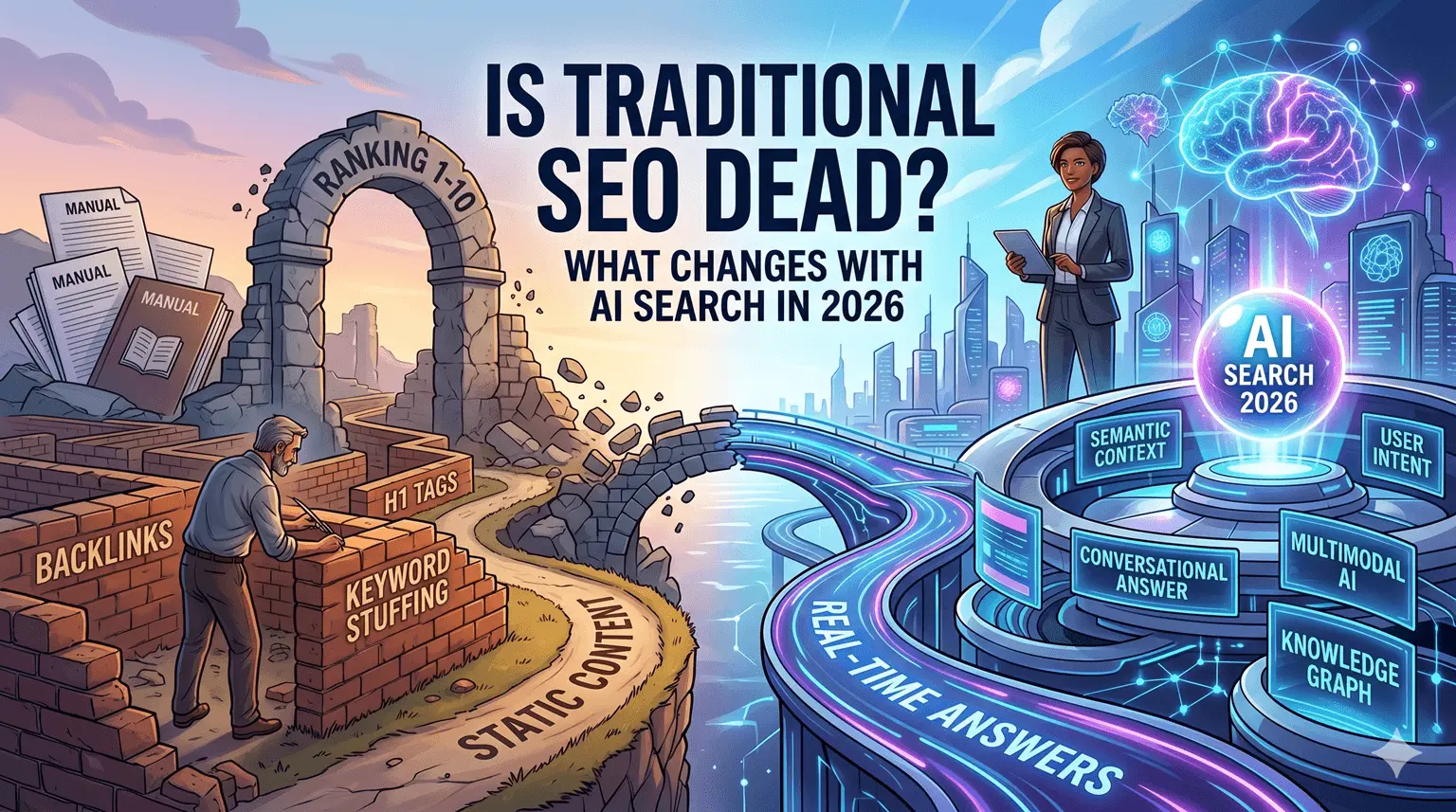
Every few months, someone declares SEO dead. It happened when social media took off. It happened when voice search arrived. And now, with AI Overviews, ChatGPT, and Perplexity reshaping how people find information, the funeral invitations are flying again.
So let’s settle this once and for all — with data, not panic.
The short answer: Traditional SEO is not dead. But the old playbook needs a serious rewrite.
Here’s what’s actually changed, what still works, and what you need to do right now.
The State of Search in 2026: What the Data Actually Says
SEO & AI Search
Key Statistics 2026
What the numbers actually say about the state of search
Before we talk about what’s changing, let’s look at what the numbers tell us.
Google still processed billions of queries a day in 2025, and organic search remains the largest driver of measurable web traffic for most brands. But the landscape around it has shifted significantly.
According to a January 2026 report by Graphite, organic search traffic has declined by only 2.5% between February 2024 and November 2025 — not the catastrophic 25–50% some panic-driven headlines predicted. The total search pie, in fact, got bigger. Combined usage of search engines and AI tools increased by 26% worldwide
At the same time, some very real disruptions are happening:
- AI Overviews now appear in up to 48% of search queries in certain categories (various studies, March 2026)
- Zero-click searches have climbed to 60–83% depending on whether an AI Overview is present, and up to 93% in AI Mode
- ChatGPT has crossed 900 million weekly active users as of early 2026 — up from 400 million in February 2025
- 51% of B2B software buyers now start their research with an AI chatbot, though 61% still use AI search and Google together
So yes, real shifts are happening. But they’re not the death of SEO — they’re a restructuring of how SEO value is delivered.
Why “SEO is Dead” Is Still Wrong in 2026
Let’s kill this myth properly.
Google still controls 89% of all U.S. web traffic as of 2025. Even with AI tools gaining ground, Google hasn’t been dethroned — it’s evolved. The platform is rolling out more than 12 algorithm changes per day, embedding AI directly into its search results, and expanding features like AI Mode and AI Overviews.
Here’s the thing that often gets buried in these “SEO is dying” conversations: ChatGPT, Perplexity, and other AI tools still rely heavily on web content to generate their answers. If you’ve optimised your site well for traditional search, you’ve already done a significant portion of the work needed to appear in AI-generated responses.
Without good SEO foundations — crawlable pages, authoritative backlinks, structured content — AI engines have nothing credible to cite. They need your content to work.
What IS dead, though, is the old-school version of SEO. The one built on keyword stuffing, thin blog posts designed to hit a word count, and low-quality link schemes. That version? Gone. Good riddance, honestly.
The Big Shift: From Rankings to Citations
This is the most important concept to understand in 2026.
For the past 20 years, the goal of SEO was to rank. Get to page one. Get to position one. The higher you ranked, the more clicks you got.
That model is breaking down.
A Seer Interactive study tracking 3,119 informational search terms across 42 organisations found that organic click-through rate for queries with AI Overviews fell 61% — from 1.76% down to 0.61%.
And the Pew Research Center, tracking actual browsing behaviour from 900 US adults in real time, found that users clicked a traditional result just 8% of the time when an AI Overview appeared, compared to 15% when it didn’t.
But here’s the flip side that doesn’t get enough attention: brands cited inside AI Overviews earn 35% more organic clicks and 91% more paid clicks than those that aren’t cited at all.
The battleground has changed. You’re no longer just competing for position one. You’re competing to be the source that AI trusts enough to cite.
What Is GEO — and Why You Need to Know It Now
Traditional SEO vs
Generative Engine Optimization
Two disciplines. One winning strategy.
A new discipline has emerged alongside traditional SEO. It’s called Generative Engine Optimization (GEO).
Where SEO gets your page ranked in a list of blue links, GEO gets your brand cited inside an AI-generated answer. Think of it as SEO’s evolved cousin — same family, different game.
GEO focuses on making your content:
- Easy for AI systems to extract and summarise
- Structured so machines can understand the relationships between your ideas
- Authoritative enough that AI engines trust it as a source
- Fresh enough that AI systems (which favour recent content) keep pulling from it
Importantly, GEO does not replace SEO — it layers on top of it. According to a comprehensive guide by Enrich Labs, brands that excel at GEO in 2026 are typically the same brands with strong traditional SEO foundations.
In other words: fix your SEO, then build GEO on top. Don’t skip the basics because a new shiny thing arrived.
What Has Changed in AI Search vs Traditional SEO
5 Ways AI Search Has
Changed the SEO Playbook
Real shifts, backed by real data. No panic required.
Let’s break down the specific shifts — clearly, without jargon overload.
1. Keyword Intent Now Matters More Than Keyword Matching
Traditional SEO was obsessed with exact keyword matches. Put “best running shoes 2026” in your title, H1, URL, and a few times in the body — done.
AI search engines interpret meaning, not just words. They read your entire page and ask: “Does this content actually answer what the user is trying to accomplish?”
If your content is semantically rich and genuinely addresses the topic from multiple angles, you win. If it’s built around a keyword and nothing else, you don’t.
2. The First 200 Words Have Never Mattered More
AI systems using Retrieval-Augmented Generation (RAG) — the technology behind Google’s AI Overviews, Perplexity, and others — evaluate a page’s relevance primarily on its opening content.
According to Enrich Labs’ 2026 GEO guide, the first 200 words of any article should directly and completely answer the primary query. If you bury the answer under three paragraphs of scene-setting, AI engines are more likely to skip you.
This also happens to be exactly what users want. So it’s a win-win.
3. E-E-A-T Is Now the Deciding Factor — Not Just a Ranking Signal
E-E-A-T: The Trust Signal
That Powers AI Citations
Google’s most important quality framework — now the deciding factor in AI search too
Google’s E-E-A-T framework — Experience, Expertise, Authoritativeness, and Trustworthiness — has been part of its quality guidelines for years. In 2026, it has become the most important filter both for traditional rankings and for AI citation decisions.
AI engines are under intense scrutiny not to spread misinformation. So they have a strong preference for sources they can verify:
- A named author with a verifiable professional background
- Publication dates and last-updated dates on every page
- Inline citations and links to original sources
- Consistent mentions across trusted external platforms
If your content reads like it was written by “the team” with no clear author, no references, and no external validation, AI systems are less likely to trust it — regardless of how well it ranks.
4. Page-One Rankings No Longer Guarantee AI Citations
This one genuinely surprised the SEO industry.
An analysis of citation patterns found that the top-10 citation rate from AI responses dropped from 76% to 38% — meaning ranking on page one of Google is no longer a reliable path to being cited in AI answers.
AI systems increasingly pull from Reddit threads, niche authority sites, and structured data sources that may not even appear in the traditional top 10. Reddit and LinkedIn, for example, are among the two most-cited domains across ChatGPT, Perplexity, and Google AI Mode.
Your brand’s presence beyond your own website now directly influences whether AI recommends you.
5. AI Traffic Converts Better — Even If There’s Less of It
AI Search Traffic Growth
vs Traditional SEO in Numbers
How the search landscape actually shifted — and what it means for your strategy
Here’s the data point that should actually make you feel better about this whole situation.
Visitors arriving from AI citations convert at rates 4.4 times higher than traditional organic search visitors.
Fewer clicks, yes. But the people who do click have already read an AI summary that confirmed you’re a credible source. They’re further along in their decision-making. They arrive pre-qualified.
So even if AI Overviews reduce raw traffic, being cited in them can improve your bottom line. The metric to track isn’t just traffic — it’s the quality of that traffic.
What Still Works: Traditional SEO Fundamentals That Haven’t Changed
Panic is a terrible strategy. Before you throw out your entire SEO playbook, here’s what remains firmly intact.
Technical SEO is still essential. AI systems rely entirely on crawlable, well-structured, authoritative web content. If your site can’t be crawled properly, AI engines can’t cite you. Page speed, mobile optimisation, structured data, and clean architecture still matter enormously.
Backlinks and brand authority still count. Traditional SEO uses backlinks to determine credibility. AI SEO broadens this — it values any mention of your brand or content in authoritative sources, including nofollow links, reviews, forum citations, and quotes in industry publications. Link building isn’t dead. It just involves reputation more than ever.
Long-form, comprehensive content still wins. AI models favour content that thoroughly addresses a topic. Single-keyword pages with thin coverage are losing both in traditional rankings and in AI citations. Depth and completeness are rewarded.
Content freshness matters more than before. According to LLMrefs’ GEO guide, there’s a measurable “3-month citation cliff” — AI systems increasingly favour recently updated content. Brands that publish and refresh content regularly maintain higher AI visibility.
A Real-World Example: Traditional + AI SEO Working Together
Want proof this isn’t just theory? Consider what Neil Patel’s agency NP Digital achieved for their client RefiJet, a motorcycle and auto loan refinancing company, by blending traditional SEO with modern AI search principles.
Their strategy combined classic technical SEO (crawlability, site speed, structured data) with on-page optimisation for long-tail intent queries and Retrieval-Augmented Generation (RAG) techniques to build authority across the web.
The results were significant: SERP features increased by 30,800%, top-three Google rankings grew by 522% year-over-year, and traffic from LLMs jumped by 2,012%. Most importantly, funded loans from organic search and LLMs rose by 178% year-over-year.
That’s what a blended approach looks like in practice. Traditional SEO and AI optimisation aren’t competing strategies — they’re a combined one.
What You Should Actually Do Right Now
This isn’t a theoretical exercise. Here are the practical steps that matter in mid-2026.
Add two new columns to your monthly SEO report. Track your AI Overview appearance rate for your top 100 keywords, and track LLM brand mention counts. If your current stack can’t pull these numbers, your measurement setup needs updating.
Answer the question in the first paragraph. Stop writing slow-burn intros. AI engines and users both want the answer immediately.
Put a real author on every article. Name, bio, credentials, LinkedIn profile. This directly influences E-E-A-T and AI citation decisions.
Cite your sources inline. This guide does exactly this. It signals credibility to both Google’s quality raters and to AI systems evaluating whether your content is trustworthy enough to recommend.
Build your brand presence across platforms. Your website alone is no longer enough. Consistent presence on LinkedIn, Reddit, YouTube, and industry publications directly influences AI citation rates. Semrush data confirms that Reddit and LinkedIn are among the most-cited domains across major AI platforms.
Refresh your content regularly. Don’t publish and forget. Update your key articles every three months at minimum.
Invest in structured data. Schema markup helps both traditional search and AI engines understand the context, structure, and credibility of your content.
The Bottom Line
Traditional SEO isn’t dead. It’s the foundation that everything else builds on.
What’s changed is the layer above it. AI search has added a new competitive arena where citations matter more than rankings, where trust signals matter more than keyword density, and where your brand’s presence across the entire web matters more than just your own website.
The brands losing in 2026 are those that either panicked and abandoned SEO entirely, or ignored AI search and kept running the same 2019 playbook.
The brands winning are doing both — maintaining strong technical and content SEO while adding GEO optimisation on top.
It’s not SEO versus AI search. It’s SEO and AI search. The playbook evolved. Time to update yours.
Frequently Asked Questions
Is traditional SEO completely dead in 2026?
No, traditional SEO is not dead in 2026. Google still controls roughly 89% of U.S. web traffic, and organic search remains the single largest driver of measurable traffic for most businesses. What has changed is that the old tactics — keyword stuffing, thin content, low-quality links — no longer work. Modern SEO demands high-quality, authoritative, user-first content. The fundamentals of technical SEO, E-E-A-T, and link authority remain as important as ever, but they now also power your AI search visibility.
How do AI Overviews affect organic click-through rates?
The impact is real but nuanced. Pew Research Center data showed that users clicked a traditional result just 8% of the time when an AI Overview appeared, compared to 15% without one. However, brands that are actually cited inside the AI Overview earn 35% more organic clicks than those who aren’t cited at all. This means the goal isn’t to avoid AI Overviews — it’s to earn a citation within them. Being the cited source reverses the click penalty entirely.
What is Generative Engine Optimization (GEO)?
Generative Engine Optimization (GEO) is the practice of optimising your content so AI systems like ChatGPT, Google AI Overviews, Gemini, and Perplexity cite your brand in their generated answers. Unlike traditional SEO, which targets a ranking position in a list of blue links, GEO targets inclusion in an AI-written response. It focuses on content structure, citation-friendliness, factual specificity, clear authorship, and topic comprehensiveness. GEO complements traditional SEO — it does not replace it.
Does ranking number one on Google still matter in 2026?
Ranking number one still matters, but it is no longer the whole story. An analysis of AI citation patterns found that the top-10 citation rate from AI-generated answers dropped from 76% to 38%, meaning page-one rankings no longer reliably translate into AI visibility. You can rank number one and still be invisible to AI engines — and vice versa. A dual strategy is necessary: optimise for traditional rankings and separately optimise for AI citation worthiness.
How does E-E-A-T affect AI search results?
E-E-A-T (Experience, Expertise, Authoritativeness, Trustworthiness) has become the most important quality filter in both traditional SEO and AI search. AI systems are designed to avoid spreading misinformation, so they strongly prefer content from verifiable, credible sources. Practical steps include adding a named author with a professional bio and credentials, including publication and last-updated dates, citing original sources inline, and maintaining a consistent presence on reputable external platforms. Strong E-E-A-T signals improve both traditional rankings and AI citation rates simultaneously.
What does AI search traffic actually look like compared to organic traffic?
AI referral traffic is growing rapidly — up 527% year-over-year according to 2026 data — but it remains smaller in volume than traditional organic traffic for most sites. What makes it notable is quality: visitors arriving from AI citations convert at rates approximately 4.4 times higher than traditional organic visitors, according to a 2025 analysis. These users have already consumed an AI summary that recommended your brand. They arrive with higher intent and more trust, making AI traffic disproportionately valuable despite lower click volumes.
Should I create content specifically for ChatGPT and Perplexity?
You don’t need separate content for each AI platform. The same principles that make content citation-worthy across one AI system generally apply to all of them. Focus on comprehensive, well-structured content that answers the question clearly in the opening section, demonstrates real expertise, cites credible sources, and maintains consistent factual accuracy. Keeping content updated regularly also helps, as AI systems show a measurable preference for recently refreshed material. One well-optimised, authoritative piece of content can earn citations across multiple AI platforms simultaneously.
Are backlinks still important in the age of AI search?
Yes, backlinks remain important in 2026, but their role has broadened. Traditional SEO used backlinks primarily as authority signals through hyperlinks. AI search expands this to include any credible mention of your brand — nofollow links, brand quotes in articles, reviews on authoritative platforms, citations in forum threads, and social media mentions. AI systems are evaluating your reputation and credibility across the entire web, not just your link profile. Building genuine authority through digital PR, expert commentary, and consistent community presence is now as important as traditional link building.
How much has AI search actually grown compared to traditional search?
The growth figures are significant. ChatGPT alone crossed 900 million weekly active users by early 2026. McKinsey surveys from August 2025 found that 50% of consumers now intentionally seek out AI-powered search tools, and for the first time, AI-powered search ranked as the number-one digital source people use when making buying decisions. At the same time, traditional search has not collapsed — total combined search usage (search engines plus AI tools) increased by 26% worldwide between early 2025 and early 2026. The market grew; it didn’t simply shift.
How do I measure SEO success now that AI search has changed the metrics?
Your measurement approach needs to expand beyond traditional metrics. Standard KPIs like organic clicks, impressions, and keyword rankings still matter, but they now tell only part of the story. In 2026, you should also track your AI Overview appearance rate for target keywords, LLM brand mention frequency across platforms like ChatGPT and Perplexity, zero-click share by query type, and the conversion rate of traffic arriving from AI citation sources. Only 16% of brands currently have a systematic way to track AI search performance — getting this visibility is a genuine competitive advantage.