
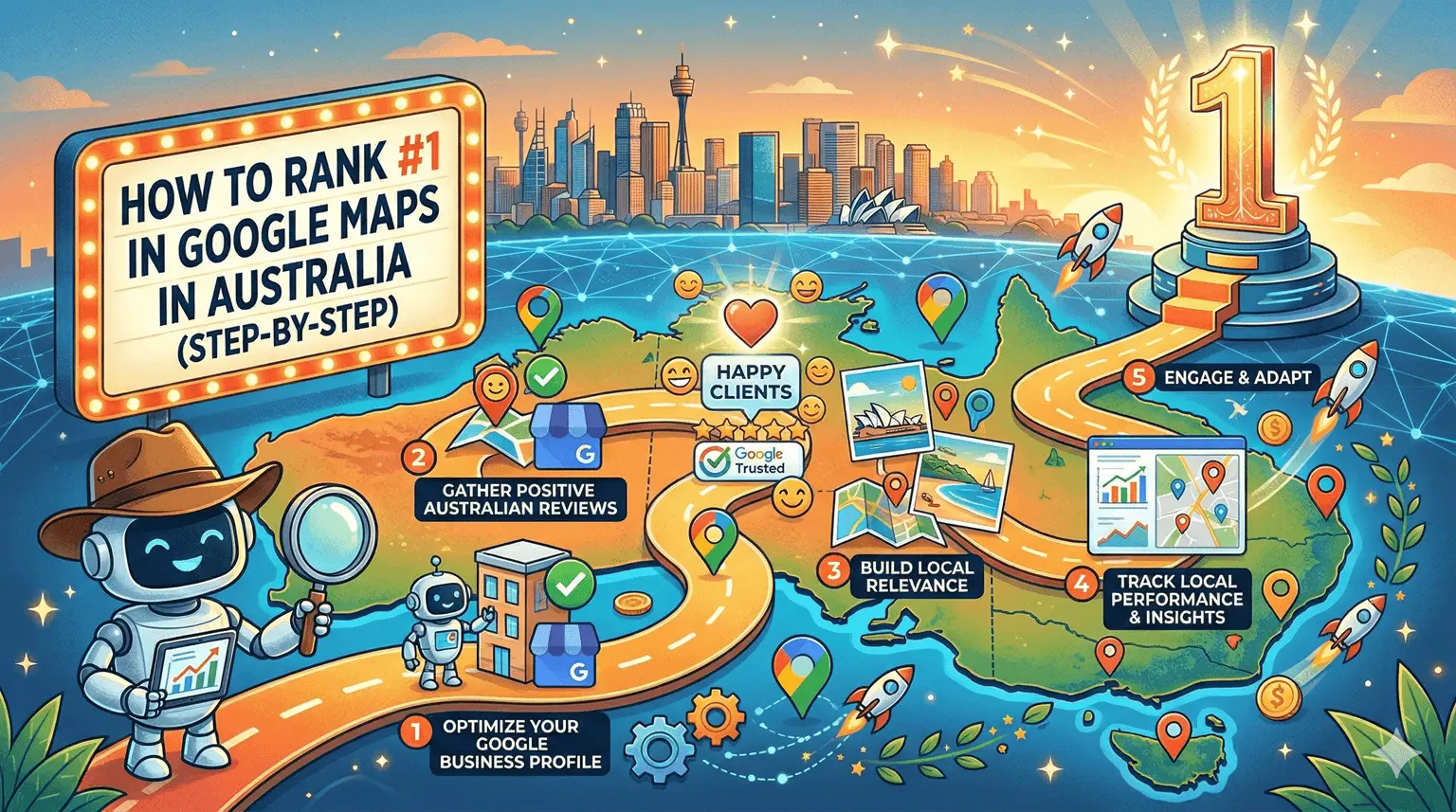
To rank #1 in Google Maps in Australia, optimize your Google Business Profile, collect high-quality customer reviews, maintain consistent business information across directories, and build strong local SEO signals through content, backlinks, and user engagement.
Key Steps to Improve Google Maps Ranking Fast:
- Fully optimize your Google Business Profile with accurate categories, services, and photos
- Get consistent, high-quality customer reviews and respond to them regularly
- Ensure your business name, address, and phone number (NAP) are identical across all listings
- Create location-based content targeting Australian cities and suburbs
- Build local backlinks from trusted Australian websites and directories
- Post regular updates on your Google Business Profile to increase activity signals
- Improve user engagement through clicks, calls, and direction requests
What Impacts Google Maps Rankings?
Google ranks local businesses based on:
- Relevance – how well your business matches the search query
- Distance – proximity to the searcher
- Prominence – reviews, backlinks, citations, and overall authority
How Long Does It Take to Rank?
Most businesses see improvement within 2–4 weeks, while reaching top positions typically takes 1–3 months, depending on competition and optimization quality.
If you run a local business in Australia, showing up on Google Maps isn’t optional anymore—it’s survival.
When someone searches “digital marketing company near me” or “plumber near me” or “best cafe in Sydney”, they don’t scroll endlessly. They click one of the top 3 map results (also called the Local Pack). If you’re not there, you’re invisible.
Let’s fix that.
This guide breaks down exactly how to improve your Google Maps ranking in Australia, using proven local SEO strategies, not outdated tricks.
Why Google Maps Ranking Matters in Australia
Australia has one of the highest mobile search usage rates globally. Most local searches come with intent:
- “near me”
- “open now”
- “best in [city]”
These are high-conversion searches.
According to Google’s own documentation, local search ranking depends on three core factors:
- Relevance
- Distance
- Prominence
Source: Google Business Profile Help (formerly GMB)
You can’t control distance. But you can dominate relevance and prominence.
Step 1: Fully Optimize Your Google Business Profile (GBP)
Your Google Business Profile (GBP) is the foundation of Google Maps ranking.
If it’s incomplete, you’re already losing.
Key Optimizations:
- Use your exact business name (no keyword stuffing)
- Select the correct primary category
- Add secondary categories
- Write a keyword-rich but natural description
- Upload real photos regularly
- Keep business hours accurate
Pro Tip:
Choose categories based on what your customers actually search.
For example:
- “Digital Marketing Agency” (primary)
- “SEO Service”
- “Internet Marketing Service”
Step 2: Use Keywords Smartly (Not Aggressively)
You mentioned keywords like:
- google maps ranking australia
- local seo australia
- how to rank in google maps australia fast
Let’s be clear—Google does NOT reward keyword stuffing anymore.
Instead, use semantic SEO.
Where to Use Keywords:
- Business description
- Services section
- Posts on GBP
- Website landing pages
- FAQs
Example (Natural Usage):
“We help businesses improve their Google Maps ranking in Australia using proven local SEO strategies.”
Clean. Natural. Effective.
Step 3: Build High-Quality Local Citations
A citation is any mention of your business name, address, and phone number (NAP).
Consistency is critical.
Top Australian Citation Sites:
- Yellow Pages Australia
- True Local
- Yelp Australia
- Hotfrog
- StartLocal
Rule:
Your NAP must be 100% identical everywhere.
Even small differences hurt your ranking.
Step 4: Get More Google Reviews (And Respond Properly)
Reviews are a major ranking factor for Google Maps.
More importantly, they influence click-through rate.
What Works in 2026:
- Ask every satisfied customer for a review
- Send direct review links via SMS or email
- Respond to ALL reviews (yes, even negative ones)
Example Response Strategy:
- Thank positive reviews
- Address issues in negative reviews calmly
- Include subtle keywords naturally
Example:
“Thanks for choosing our local SEO services in Australia—we’re glad we could help!”
Step 5: Optimize Your Website for Local SEO Australia
Your website supports your Maps ranking.
Google cross-checks your site with your GBP.
Must-Have Elements:
- Location-based pages (e.g., “SEO Services Sydney”)
- Embedded Google Map
- Local schema markup
- Fast loading speed (Core Web Vitals)
- Mobile-friendly design
Internal Linking Tip:
Link your blog content to service pages.
Example:
Blog → “How to rank in Google Maps Australia fast” → Service page
This builds topical authority.
Step 6: Create Location-Based Content
Content is still king—but local content is emperor.
Blog Ideas:
- “How Google Maps ranking works in Australia”
- “Local SEO tips for small businesses in Melbourne”
- “Why your business isn’t showing on Google Maps”
This builds:
- Authority
- Relevance
- Traffic
Step 7: Use Google Business Profile Posts
Most businesses ignore this. Big mistake.
GBP posts increase engagement and freshness signals.
Post Types:
- Offers
- Updates
- Events
- Tips
Example:
“Struggling with Google Maps ranking in Australia? Here’s a quick fix…”
Post weekly.
Step 8: Build Local Backlinks
Backlinks still matter – but local ones matter more.
Where to Get Them:
- Local blogs
- News websites
- Business directories
- Sponsorships
- Partnerships
Example:
Sponsor a local event → get featured → earn a backlink
Step 9: Optimize for “Near Me” Searches
Google uses proximity + relevance.
You can boost relevance by:
- Adding suburbs and cities naturally
- Creating geo-targeted pages
- Using local keywords in headings
Example Keywords:
- local seo australia
- seo agency in sydney
- google maps ranking melbourne
Step 10: Improve Behavioral Signals
Google tracks how users interact with your listing.
Important Metrics:
- Clicks
- Calls
- Direction requests
- Time spent
How to Improve:
- Add attractive photos
- Write compelling descriptions
- Use clear CTAs
Step 11: Use Photos & Videos Strategically
Listings with images get more engagement.
What to Upload:
- Office/store photos
- Team photos
- Before/after results
- Short videos
Update regularly.
Step 12: Fix Technical Issues
Even small issues can hurt rankings.
Check:
- Duplicate listings
- Wrong categories
- Inconsistent NAP
- Suspended profiles
Use Google Business Profile support if needed.
How to Rank in Google Maps Australia Fast (Reality Check)
Let’s be honest.
There’s no instant ranking hack.
But you can accelerate results by focusing on:
- Reviews (fastest impact)
- GBP optimization
- Citation cleanup
- Local backlinks
Timeline:
- 2–4 weeks: Visibility improvement
- 1–3 months: Ranking growth
- 3–6 months: Top 3 potential
Common Mistakes to Avoid
Avoid these if you want long-term rankings:
- Keyword stuffing business name
- Fake reviews
- Inconsistent business info
- Ignoring negative reviews
- Using low-quality backlinks
Google is smarter in 2026. Shortcuts don’t last.
Final Thoughts
Ranking #1 on Google Maps in Australia isn’t about tricks.
It’s about:
- Trust
- Consistency
- Relevance
If you:
- Optimize your Google Business Profile
- Build strong local SEO signals
- Focus on real user experience
You’ll not only rank—you’ll convert.
And that’s what actually matters.
Quick Checklist
✔ Fully optimized GBP
✔ Consistent NAP across directories
✔ High-quality reviews
✔ Local SEO optimized website
✔ Location-based content
✔ Local backlinks
✔ Regular GBP activity
Frequently Asked Questions (FAQs)
1. How long does it take to rank on Google Maps in Australia?
Most businesses see initial improvements within 2–4 weeks after optimizing their Google Business Profile. However, reaching the top 3 positions usually takes 1 to 3 months, depending on competition and consistency in local SEO efforts.
2. What is the most important factor for Google Maps ranking?
Google officially highlights relevance, distance, and prominence. Out of these, you can directly improve relevance (optimization) and prominence (reviews, backlinks, citations) to boost your ranking.
3. How can I improve my Google Maps ranking fast in Australia?
Focus on:
- Optimizing your Google Business Profile
- Getting more genuine customer reviews
- Fixing inconsistent business listings
- Posting regularly on your profile
These actions deliver the fastest visible results.
4. Do reviews really help in Google Maps ranking?
Yes. Reviews are a major ranking signal. Businesses with more high-quality and recent reviews tend to rank higher and also get more clicks from users.
5. Can I rank in multiple cities in Australia with one business?
Yes, but only if you create location-specific landing pages and build relevance for each area. Avoid fake addresses—Google can penalize your listing.
6. What are local citations and why are they important?
Local citations are mentions of your business details (Name, Address, Phone). They help Google verify your business legitimacy and improve your local SEO in Australia.
7. Is a website necessary to rank on Google Maps?
Technically no, but practically yes. A well-optimized website strengthens your authority and helps Google trust your business, improving your overall rankings.
8. How often should I update my Google Business Profile?
You should update your profile at least once a week using posts, photos, or offers. Regular activity signals that your business is active and trustworthy.
9. Why is my business not showing on Google Maps?
Common reasons include:
- Incomplete profile
- Wrong business category
- Low reviews
- High competition
- Inconsistent business information
Fixing these usually improves visibility.
10. Does local SEO work for small businesses in Australia?
Absolutely. Local SEO is one of the highest ROI strategies for small businesses because it targets users who are ready to take action, such as calling or visiting your business.
