
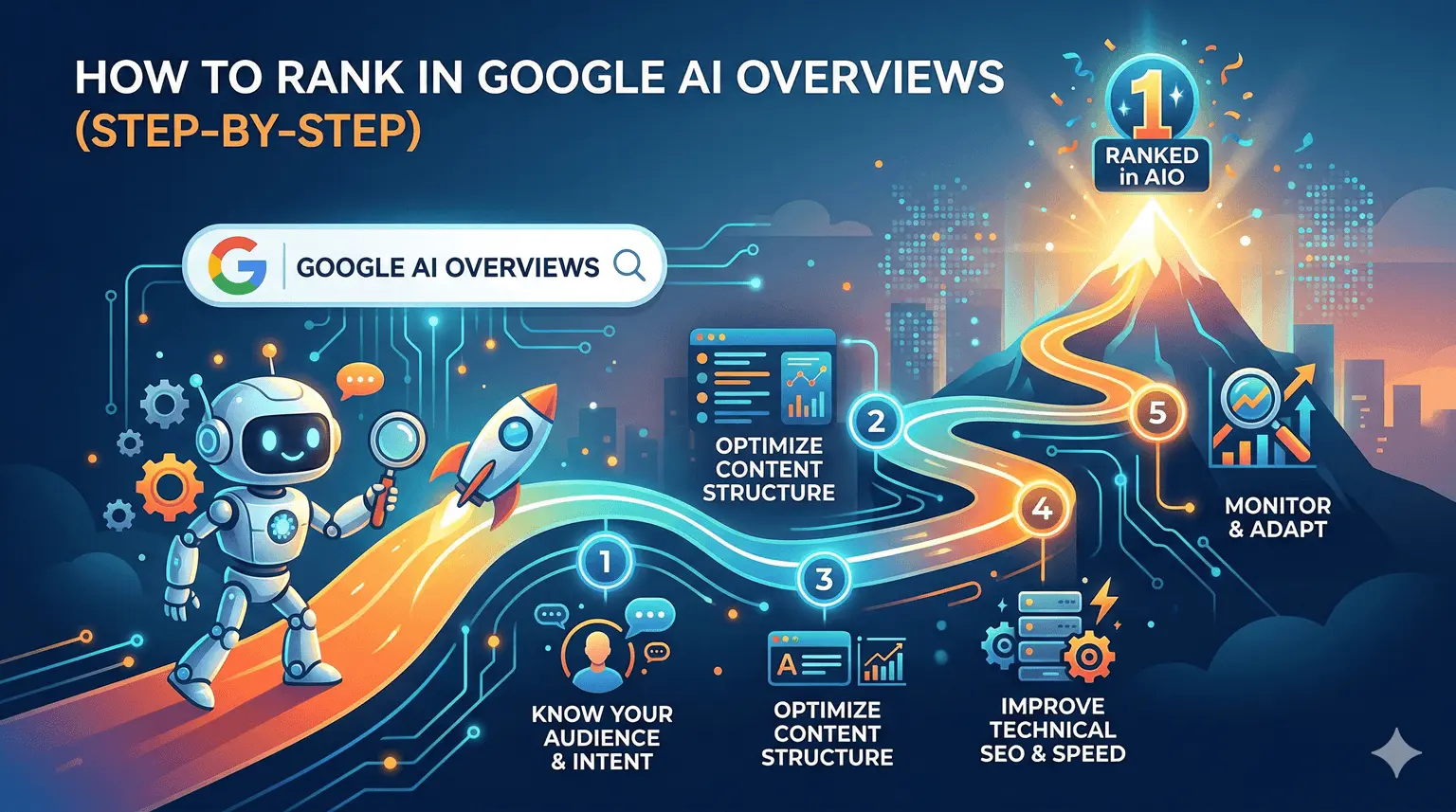
Let’s be honest — Google just changed the rules of the game again. And this time, the changes are big.
Google AI Overviews (AIO) are now appearing in over 60% of all searches, a massive jump from just 25% in mid-2024. In industries like healthcare and education, that number has climbed to 83–88% of queries. If your content isn’t showing up in these AI-generated summaries, you’re losing visibility — fast.
The good news? You don’t need to rank #1 to get cited. In fact, roughly 47% of AI Overview citations come from pages that don’t even rank in the top 5 for that query. That changes everything about how you should approach SEO in 2026.
This guide covers exactly what Google’s AI Overviews are, how they choose sources, and what you need to do — step by step — to get your content cited and seen.
What Are Google AI Overviews, Exactly?
Google AI Overviews are AI-generated summaries that appear at the very top of Google search results. Powered by Google’s Gemini 2.0 model, they pull content from multiple web sources and synthesize it into a single, direct answer.
They’re not just featured snippets wearing a tuxedo. Featured snippets quote one source. AI Overviews synthesize several — which means more opportunities for your content to get cited, but also more competition for that spotlight.
As of early 2026, AI Overviews exceed 1,200 pixels in height on desktop — that’s taller than most screens. On mobile, they take up roughly 48% of screen real estate. If your content isn’t inside the overview, you’re essentially invisible above the fold.
Why You Can’t Ignore This Anymore
Here’s the reality check no one wants to give you:
Traditional organic CTR has dropped 61% for queries that trigger AI Overviews (from 1.76% to 0.61%). That’s not a rounding error — that’s a collapse. Position #1 isn’t safe either. CTR for top-ranking pages fell by up to 58% on queries with AI Overviews present.
But here’s the flip side — if your content gets cited inside an AI Overview, you earn 35% more organic clicks than competitors who aren’t cited. So the goal isn’t to fight AI Overviews. It’s to get inside them.
Now let’s talk about how to actually do that.
Step 1: Understand How Google Chooses AI Overview Sources
Before you optimize, you need to know what you’re optimizing for.
Google’s AI doesn’t pick sources randomly. It runs your content through the same core ranking systems — helpful content, spam filters, freshness signals — plus additional AI-specific criteria. The single strongest predictor of AI Overview inclusion is something called semantic completeness: how thoroughly your content answers a query without needing external help.
Research analyzing nearly 16,000 AI Overview results found that content scoring 8.5/10 or above on semantic completeness was 4.2× more likely to appear in AI Overviews.
Traditional Domain Authority? Barely a factor anymore (correlation of just r=0.18). Google’s AI is genuinely looking for the best answer, not just the biggest website.
Step 2: Target the Right Queries
Not every search triggers an AI Overview. Google is selective — but there are clear patterns.
Queries phrased as questions or how-to’s are now 84% more likely to display an AI Overview. Long-tail queries of eight words or more are 7× more likely to trigger one. “How to get cited in Google AI Overviews from a low-ranking position” is far more likely to trigger an AI Overview than “AI Overview tips.”
What to do:
- Use tools like AnswerThePublic, Google’s “People Also Ask” section, and your own customer FAQs to build a list of question-based queries.
- Focus on long-tail, conversational keywords that match how people actually speak.
- Look for queries in your niche where AI Overviews are already appearing — those are your highest-opportunity targets.
Step 3: Lead With a Direct Answer (Every Single Time)
This is the biggest structural shift most content creators need to make.
AI models read content like a smart intern with no patience for preamble. They want the answer first. Supporting details second. Story of how you discovered the answer? Save that for your memoir.
The inverted pyramid model is non-negotiable for AI Overview optimization.
Start every article or section with a direct, self-contained answer of 50–70 words. Think of it as a TL;DR that also happens to be your best shot at getting cited. Don’t bury your answer in paragraph five after a lengthy introduction about the history of the topic.
The AI needs to be able to extract a complete answer from your content without needing to click anywhere else. If your content requires context from another page to make sense, it won’t get cited.
Step 4: Build Real E-E-A-T Signals
Google’s E-E-A-T framework (Experience, Expertise, Authoritativeness, Trustworthiness) has always mattered for SEO. For AI Overviews, it matters even more — and it’s more verifiable than ever.
Google’s AI doesn’t just read your site. It cross-references your identity and authority across the entire web. Think of it less like a ranking algorithm and more like a background check.
Practical E-E-A-T steps:
- Add clear author bios with real credentials, linked to LinkedIn or professional profiles.
- Cite authoritative sources — government sites, academic journals, peer-reviewed studies — not content aggregators.
- Use Person schema to formally link your author to their credentials so Google can verify them.
- Get mentioned externally — the more other credible sites reference your content or brand, the stronger your trust signals become.
Research shows that content with authoritative citations earns a 132% increase in AI Overview visibility compared to content without them. That’s not a number you ignore.
Step 5: Implement Schema Markup (Don’t Skip This)
Here’s where technical SEO and AI optimization genuinely overlap.
Schema markup is the direct communication channel between your content and Google’s AI systems. It tells Google exactly what type of content you’re publishing, who wrote it, what questions it answers, and how it’s structured.
Priority schema types for AI Overview optimization:
- FAQPage schema — Pages with FAQPage markup are 3.2× more likely to appear in Google AI Overviews. Only about 12.4% of websites use structured data at all, so this is still a significant competitive edge.
- HowTo schema — For step-by-step guides. If you’re writing instructional content, mark it up.
- Article + Author schema — Connects your content to a real, verifiable author with credentials.
- Organization schema — Establishes your brand identity in Google’s Knowledge Graph.
Always use JSON-LD format. Google officially recommends it over Microdata and RDFa, and it keeps your markup separate from your HTML, making it easier to maintain. Validate everything using Google’s Rich Results Test before publishing.
Step 6: Structure Your Content for AI Parsing
Key metric: semantic completeness score
Content scoring 8.5/10+ is 4.2× more likely to appear in AI Overviews
Target zone: 8.5 and above (red marker)
AI models don’t skim. They parse. The way your content is structured determines how much of it — and which parts — get extracted and cited.
Content structure checklist:
- Use H1 → H2 → H3 heading hierarchy logically, not for aesthetics. Each heading should clearly describe what follows.
- Write paragraphs of 2–4 sentences maximum. Long blocks of text are harder for AI to extract meaningful segments from.
- Use FAQ-style sections within longer articles. Questions that mirror what people actually search for perform best.
- Include internal links to related content — this signals topical authority and helps AI understand the depth of your expertise on a subject.
- Use semantic HTML properly —
<article>,<section>,<header>— rather than generic<div>soup. It gives AI systems genuine structural context.
Step 7: Keep Your Content Fresh and Factually Verified
AI Overviews heavily favor timely, accurate content. Google’s AI is built to fact-check in real time, and stale or inaccurate content gets filtered out.
For content you want to maintain in AI Overviews:
- Add a visible “Last Updated” date near the top of any guide or evergreen article.
- Refresh key stats and examples at least once or twice a year more often for fast-moving topics like AI search itself.
- Cite primary data sources rather than secondary roundups. If you’re referencing a study, link to the study – not to the blog post that summarized the study.
- Consider adding a short “What’s Changed” note when you update articles. It signals freshness without requiring a complete rewrite.
Step 8: Don’t Neglect Technical SEO Fundamentals
AI Overviews don’t operate in a vacuum. They still run on Google’s core infrastructure, which means all your standard technical SEO still matters.
Poor Core Web Vitals, slow load times, and broken mobile experiences all reduce engagement signals — and lower engagement signals reduce your chances of AI Overview selection.
Technical baseline checklist:
- HTTPS on every page (non-negotiable)
- Core Web Vitals in the green, especially LCP (Largest Contentful Paint) and CLS (Cumulative Layout Shift)
- Mobile-responsive design — about two-thirds of Google searches happen on mobile, and AIO triggers are highest on mobile
- Clean site architecture with logical URL structure
- Proper canonical tags to prevent duplicate content issues
Why Your Site Might Not Be Appearing in AI Overviews
If your content isn’t showing up despite your efforts, here are the most common reasons:
1. Your content doesn’t have a clear, direct answer. AI needs extractable answers, not vague explorations.
2. You’re targeting queries that don’t trigger AI Overviews. Very short or very simple queries often don’t. Check if AI Overviews even appear for your target keywords.
3. Your E-E-A-T signals are weak. No author information, no citations, no external mentions — Google’s AI can’t verify your expertise.
4. Missing schema markup. Without structured data, AI systems have to guess at your content structure.
5. Outdated content. If your last update was two years ago, the AI will prefer fresher sources.
6. Technical issues blocking crawl or indexing. Check Google Search Console regularly for crawl errors and indexing issues.
Can You Rank in AI Overviews Without Backlinks?
Yes — but it’s harder. Backlinks still matter as a trust signal, though their correlation to AI Overview inclusion is weaker than for traditional rankings. Domain Authority now has a correlation of just r=0.18 with AI Overview selection, compared to much stronger signals like semantic completeness and E-E-A-T.
A mid-authority site with brilliantly structured, deeply helpful content has a realistic shot at AI citations. A high-authority site with shallow, poorly structured content may not get a look.
The Honest Summary
Ranking in Google AI Overviews isn’t a trick or a hack. There’s no secret backdoor. Google themselves have said it clearly: if your site is properly optimized and your content is genuinely helpful, it has a greater chance of being featured.
What’s changed is how “helpful” gets measured. AI doesn’t reward effort or word count. It rewards clarity, completeness, verifiable expertise, and structure that makes it easy to extract a good answer.
The businesses that treat AI Overviews as an opportunity — rather than a threat — and start building toward them now will have a real edge as this technology continues to expand.
Start with one article. Get the structure right. Add your schema. Cite real sources. Then repeat.
Quick Reference Checklist
- Write a 50–70 word direct answer at the top of every article
- Target question-based, long-tail queries (8+ words)
- Add clear author bios with credentials and Person schema
- Implement FAQPage, HowTo, Article, and Organization schema (JSON-LD)
- Keep paragraphs to 2–4 sentences max
- Use logical H1 → H2 → H3 heading hierarchy
- Cite authoritative external sources (not aggregators)
- Add “Last Updated” dates and refresh content regularly
- Validate all structured data in Google’s Rich Results Test
- Check Core Web Vitals and mobile performance
- Monitor AI Overview appearances using SEO tools and Search Console
FAQs
What are Google AI Overviews and how do they work?
Google AI Overviews are AI-generated summaries that appear at the top of Google search results, powered by Google’s Gemini model. Instead of showing one featured snippet from a single source, they pull information from multiple web pages and synthesize it into one direct answer. Google selects sources based on factors like content quality, E-E-A-T signals, semantic completeness, and structured data — not just traditional ranking position.
How does Google choose which sources appear in AI Overviews?
Google’s AI evaluates content based on several factors: how directly and completely it answers the query (semantic completeness), the author’s verifiable expertise and credentials (E-E-A-T), use of structured data like FAQPage and HowTo schema, content freshness, and whether the page is properly indexed with strong technical SEO. Interestingly, around 47% of AI Overview citations come from pages that don’t rank in the top 5 organic results — meaning content quality matters more than raw ranking position.
Can I rank in Google AI Overviews without backlinks?
Yes, it is possible — but backlinks still help as a trust signal. Domain Authority now has a very low correlation (r=0.18) with AI Overview inclusion compared to stronger signals like semantic completeness and E-E-A-T. A mid-authority website with well-structured, clearly written, and expertly cited content can realistically get cited in AI Overviews even without a large backlink profile. Focus on content quality and schema markup first.
Why is my website not showing in Google AI Overviews?
There are several common reasons. Your content may not have a clear, direct answer at the top of the page. You may be targeting queries that don’t trigger AI Overviews (short or generic keywords). Your E-E-A-T signals may be weak — no author bio, no external citations, no credentials. You may be missing schema markup like FAQPage or HowTo. Your content could also be outdated, which Google’s AI filters out in favour of fresher sources. Check all these areas before drawing conclusions.
What is the difference between Google AI Overviews and featured snippets?
Featured snippets pull a single passage from one specific webpage and display it verbatim. Google AI Overviews, by contrast, synthesize information from multiple sources into an original AI-written summary, with citations linking back to contributing pages. AI Overviews are significantly larger — often exceeding 1,200 pixels on desktop — and appear higher and more prominently than featured snippets ever did. Getting cited in an AI Overview also tends to drive more traffic than a featured snippet placement.
What is Generative Engine Optimization (GEO) and is it different from SEO?
Generative Engine Optimization (GEO) is the practice of optimizing content specifically to be cited by AI-powered search engines like Google AI Overviews, ChatGPT search, and Perplexity. It overlaps heavily with traditional SEO — technical health, E-E-A-T, and quality content matter in both — but GEO places extra emphasis on direct answers at the top of pages, semantic completeness, structured data, authoritative citations, and content that AI can extract and synthesize without needing additional context. Think of GEO as SEO’s next evolution, not a replacement.
Does schema markup really help with Google AI Overview rankings?
Yes, significantly. Pages with FAQPage schema are 3.2 times more likely to appear in AI Overviews compared to pages without it. Only around 12.4% of websites use structured data at all, which means this is still a real competitive advantage. HowTo schema works well for instructional content, while Article and Person schema help Google verify author expertise. Always implement schema in JSON-LD format and validate it using Google’s Rich Results Test before publishing.
How long should my answer be to get featured in Google AI Overviews?
The ideal direct answer at the top of your page should be between 50 and 70 words — long enough to be complete and self-contained, short enough to be extracted cleanly by AI. Think of it as a TL;DR that also serves as your best shot at being cited. The rest of your article can go deeper, but that opening answer needs to work on its own without requiring any additional context from the reader.
What is the future of search engines with AI Overviews?
AI-powered search is the direction the entire industry is moving. Google’s AI Overviews already appear in over 60% of all searches as of early 2026, and that number continues to grow. Other search engines including Bing, Perplexity, and ChatGPT Search are building similar AI answer layers. The future of search rewards content that is genuinely helpful, clearly structured, expertly authored, and easy for AI to synthesize — not content that is optimised purely for keyword density or link volume. Websites that adapt now will have a significant head start.
How do I check if my content is appearing in Google AI Overviews?
Google Search Console does not yet have a dedicated AI Overview report, but you can monitor it in a few ways. Search your target keywords manually in an incognito Chrome window and check whether your site is cited. Third-party tools like Semrush, Ahrefs, and BrightEdge have begun adding AI Overview tracking features to their dashboards. You can also track changes in organic CTR for specific queries — a sudden drop on a keyword where you rank well can indicate an AI Overview has appeared and is absorbing clicks that previously went to your listing.